
Nelson Projected Versus Actual Release
A projected release date is a current sentence calculation. It reflects the orders, credit rules, earning class, jail credit, and other information known to the responsible agency at that point. An actual release date records when the custodian completed the physical event. The dates may match, but they answer different questions. A future date can move before it arrives. A past projected date also does not prove that the person walked out, because a detainer, another charge, a later order, or transfer may have kept custody in place.
Pretrial custody is different. A person awaiting trial has not received a final jail or prison sentence from which staff can calculate a completion date. Bond, dismissal, plea, trial, and sentencing can each change the path. A court docket may show an order before ACRJ has received every required document and finished release processing. A sentenced person usually has a computed framework, but even that date remains subject to the controlling record.
Find a Nelson Projected Release Date
Start with the likely custody class and a reliable identifier. A Nelson arrest or short local sentence points to ACRJ. A seven-digit DOC ID, state felony sentence, or known VADOC authority points to the state locator and Time Computation process. If the person has only a court case and no sentence, check the correct Nelson court rather than searching for a date that does not yet exist.
- Identify whether the case is pretrial, locally sentenced, state-responsible, or federal.
- For a local term, contact ACRJ Records with the full name, booking information, Nelson jurisdiction, and case dates.
- For state responsibility, search the VADOC locator by DOC ID or by full last name and the first three letters of the first name.
- Compare the court sentence and credited pretrial time with the responsible agency's current date information.
- Ask whether a detainer, pending charge, later order, or unprocessed court document changes the date.
- After the date passes, obtain the actual release, transfer, or discharge record rather than relying on the projection.
The VADOC Time Computation page describes the state variables and the split between local and state calculations.
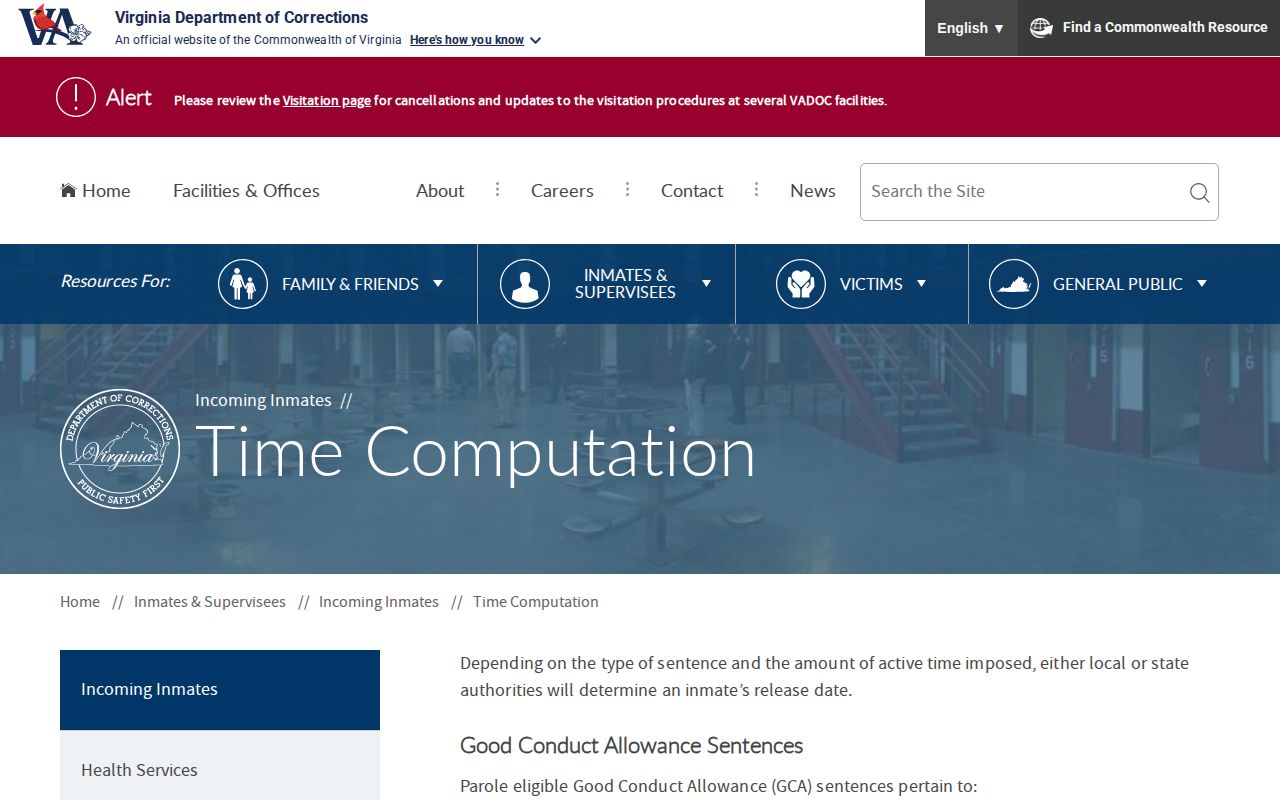
The official page helps identify the calculator, but a case-specific answer still comes from the person's current state or ACRJ record.
Virginia Credits Affect Nelson Release Dates
Pretrial confinement credit can reduce time left to serve when it is properly awarded and posted. Virginia Code § 53.1-187 governs credit for qualifying confinement before conviction and sentence. The sentence order, dates held, and whether terms run at the same time or one after another all matter. Missing or disputed jail credit should be raised through the responsible records and court channels rather than fixed with a private calendar.
The official statute page shows the legal framework for pretrial confinement credit used in a Nelson County release-date calculation.
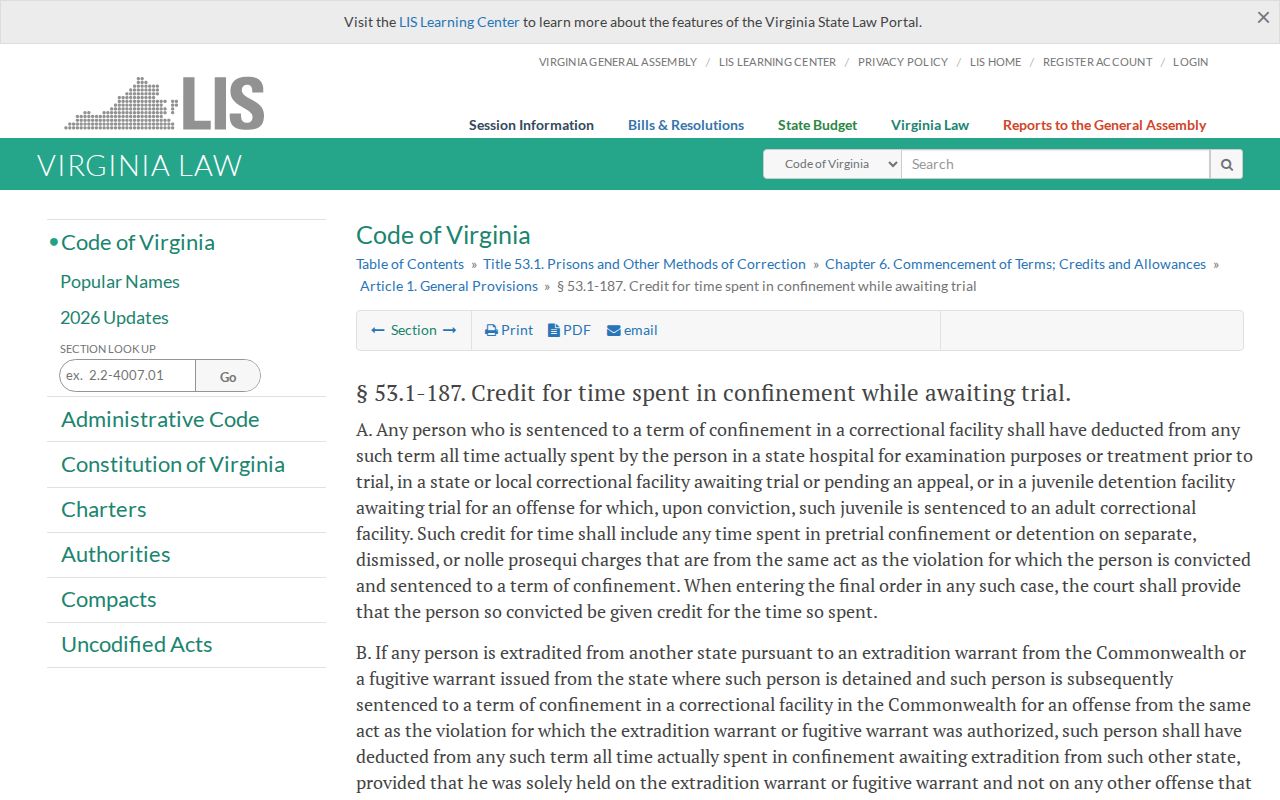
That credit is one input in the official calculation and does not establish an actual release event by itself.
Virginia's post-1995 Earned Sentence Credit system also resists a one-line formula. For offenses listed in § 53.1-202.3(A), the ESC-1 structure allows from zero to 4.5 days for each thirty days served, based on class. The maximum rate helps explain the familiar roughly eighty-five-percent shorthand. It does not mean each modern prisoner serves the same fraction. For eligible subsection B sentences, ESC-2 permits from zero to fifteen days for each thirty days, again subject to class, offense exclusions, effective dates, and statutory eligibility.
The earned-credit statute presents the rates and eligibility categories that can affect a state-responsible Nelson sentence.
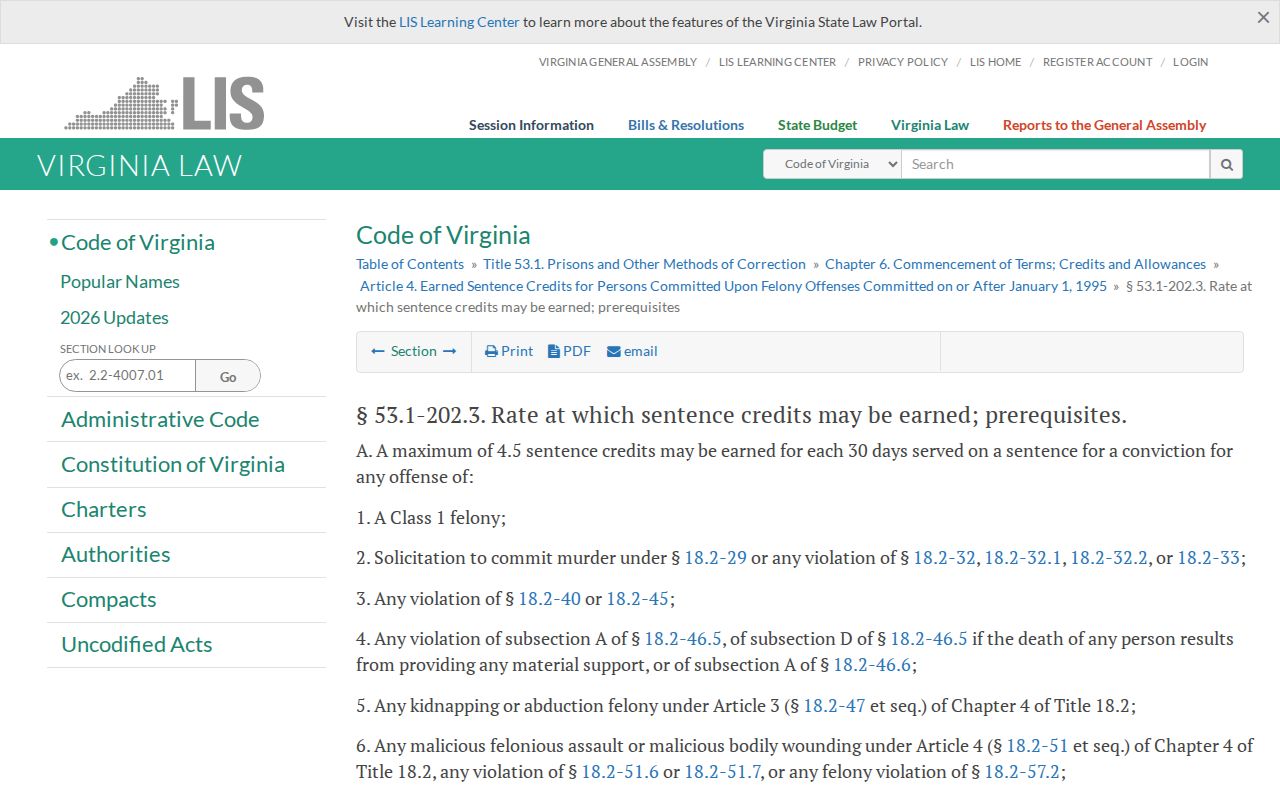
The table must be applied through the official classification and calculation, not by assigning the highest rate to an individual case.
Older Good Conduct Allowance cases can follow a different class-based scheme under §§ 53.1-201 and 53.1-202. VADOC also lists the total imposed sentence, pre-VADOC jail time, sentence type, earning class, disciplinary events, and other computation events among its variables. Offense date matters. So do later statutory versions. Earned-credit release is not the same as parole, and a credit-based date should not be labeled a parole date.
ACRJ Nelson Release Date Rules
ACRJ has local distinctions that make private arithmetic especially weak. Its Records page says felony jail-release calculations already include maximum good time, while mandatory jail sentences are excluded from good time. Eligible misdemeanor trustees may receive Jail Good Time, or JGT, at one day for each five days worked. That credit is not projected in advance. It is submitted on a biweekly basis, so a person cannot safely add future trustee credit to today's date.
Eligible misdemeanor program Earned Good Time, or EGT, is different. ACRJ describes it as five days for each thirty program days and makes it discretionary. VADOC, not ACRJ, decides credit on state-responsible sentences. These categories cannot be blended. Whether the sentence is mandatory, local, or state-responsible determines which credit may apply and who has authority to calculate it.
- JGT
- Local Jail Good Time tied to eligible misdemeanor trustee work and submitted after the work period.
- EGT
- Discretionary local Earned Good Time tied to eligible misdemeanor program participation.
- ESC
- Virginia Earned Sentence Credit for eligible state-responsible sentences under the applicable statutory class and rate.
- Mandatory time
- A required portion of a sentence that the applicable good-time rule does not reduce.
Note: ACRJ credits and VADOC sentence credits are separate systems, even when a state-responsible person remains in the regional jail building.
Why Nelson Release Dates Can Slip
ACRJ cannot process an actual release until orders arrive from every court. The jail warns that receipt can take several days. That delay is not the same as a new sentence calculation. It is an operational gap between what a docket or oral ruling may show and what the jail has received and can execute. Nelson cases may also cross General District and Circuit Court tracks, so staff may need orders connected with more than one stage or case.
A detainer can also redirect the event. A detainer is a hold or request tied to another authority. It can mean ACRJ ends its custody and transfers the person instead of releasing the person into the community. Pending charges, disciplinary events, new sentence orders, corrected jail credit, and changes in earning class can alter the date or the next destination. A Parole Board grant is another point in a process, not the physical-release date.
| Factor | Possible effect | Best check |
|---|---|---|
| Court order arrival | Processing waits until ACRJ receives all required orders. | Confirm receipt and completed action with ACRJ Records. |
| Jail or pretrial credit | Properly posted credit may reduce time remaining. | Compare the calculation with the sentence and confinement record. |
| Earning class or discipline | Credit accrual may rise, fall, or be lost. | Use the current VADOC computation record. |
| Detainer or pending charge | Release can be delayed or become a transfer. | Ask for the hold and receiving-authority information. |
| Later court action | A new or corrected order can change the calculation. | Check the final order and agency receipt. |
Verify Nelson County Release Dates
For a local sentence, call ACRJ Records at 434-977-6981 extension 303 on weekdays from 8:30 a.m. to 4 p.m. Ask for the calculated date, whether all court orders have arrived, whether a pending case or detainer affects release, and how to obtain the actual release or disposition record. Supply the full name, booking number or birth information if known, Nelson jurisdiction, and the relevant date range. A narrow records request can seek the court-order receipt, jail-credit computation, release entry, or transfer field.
For a state case, the VADOC locator is useful for current custody or community supervision, but it is not a complete historical discharge archive. VADOC policy supports release of projected parole eligibility, mandatory parole, and good-time release dates at the time of inquiry. Exact live interface labels should be read as displayed. After release, an Order of Release, notification-of-release letter, or official discharge confirmation is stronger than an old locator view. A supervision result means confinement may have ended while VADOC control continues.
A VINE alert can corroborate a reported local custody change, but it does not compute the date. Registration instructions are on the VINE Inmate Check page. For the full Nelson custody and court sequence, use the search and release-record coverage on the home page. Keep internal records, court orders, and notification events in their proper roles.
Note: Never travel to ACRJ based only on a private date calculation; Records can confirm whether paperwork, a hold, or another case still controls.